News | 05.12.2025
Ensuring the legality, sustainability, and traceability of timber is at the heart of ATIBT’s mission. As legislative frameworks strengthen worldwide—including the EU Deforestation Regulation (EUDR), CITES requirements, and due diligence obligations—new scientific tools are emerging to support operators and authorities. One of the most promising technologies now gaining momentum is Laser-Induced Breakdown Spectroscopy (LIBS), a field-capable technique capable of identifying wood origin and species with accuracy and cost-efficiency.
What is LIBS? A Fast, Portable Tool for Wood Analysis
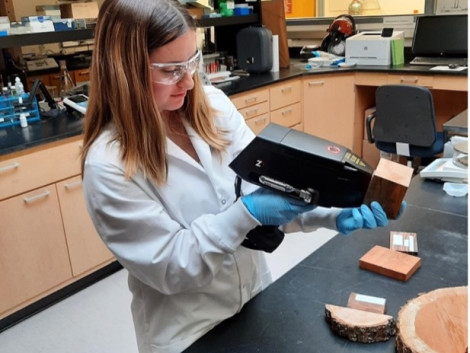
LIBS is a handheld, portable spectrometric method in which a laser pulse vaporizes a tiny amount of material from the wood surface, generating a plasma whose emission reveals the elemental composition of the sample. Unlike laboratory-bound techniques such as stable isotopes or most trace element analysis, LIBS can be used directly in the field, even on freshly cut wood, without destroying the sample.
According to research from the US Forest Service’s Wood Identification & Screening Center (WISC), LIBS is able to produce data comparable to current lab-based techniques and capable of distinguishing between tree populations as little as 14–72 km apart . Data collection takes only a few seconds, allowing hundreds of samples to be analyzed per day.
Capabilities for Species and Origin Identification
Over recent years, studies have shown that LIBS can contribute to two essential dimensions of wood verification:
LIBS has demonstrated strong ability to differentiate wood by region of harvest—at the population level in the United States, according to early trials. This could strengthen enforcement of legality frameworks such as the Lacey Act or CITES, while helping industry verify provenance claims.
The technology is being tested as part of a large-scale initiative to build a reference database for US hardwoods, supported by WISC, US universities, and the American Hardwood Export Council (AHEC). This project aims to provide US hardwood buyers in Europe and other countries the ability to verify the origin of harvest and sawmill producing the timber. Combining LIBS with with stable isotope analysis would enable even finer resolution of origin.
LIBS produces elemental “fingerprints” that can be used to identify species, including tropical and CITES-listed timbers. Recent studies show that LIBS achieves more than 85% accuracy for species identification across both tropical and temperate species .
This tool will complement anatomical and chemistry-based identification methods, while potentially offering a fast first-line tool for field inspectors, certification bodies, and industrial operators.
Advantages for the Timber Sector
LIBS offers several unique benefits with particular relevance for tropical timber supply chains:
For companies operating across complex tropical supply chains, this could become a powerful complement to documentation-based traceability systems.
Transformative Potential for Due Diligence and Chain of Custody
The US hardwood sector is already working to integrate LIBS into a reinforced chain-of-custody system (American Hardwoods Assured – AHA). According to the research, coupling origin testing with geolocation could create “the strongest and most robust chain of custody system in the industry” .
The same type of innovation could in the future benefit tropical timber operators, especially those trading into highly regulated markets:
Where the Research Is Heading
Several areas of research are advancing:
These developments could considerably expand the applicability of LIBS for the Congo Basin and other tropical forest regions.
What It Means for ATIBT Members
ATIBT closely follows technological innovations that can strengthen the credibility and competitiveness of legal, sustainable tropical timber. LIBS could become a strategic tool in:
As the technology advances, ATIBT will continue to explore collaboration opportunities with research centers and promote tools that support transparency and responsible trade.
tag(s) :