News | 26.10.2026
On 24 and 25 September 2026, the joint ACSFI–ICFPA sessions, followed by the 67th session of ACSFI, were held at FAO headquarters in Rome, Italy. These meetings highlighted the opportunities offered by forest products to address climate and economic challenges. Discussions also examined the barriers that need to be overcome to enable sustainable forest-based industries to reach their full potential.
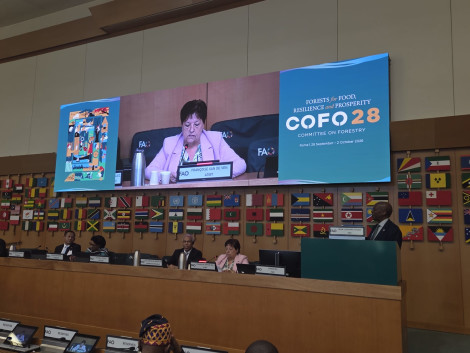
How can forest products play a greater role in an economy less dependent on fossil resources? This question ran through discussions between FAO’s Advisory Committee on Sustainable Forest-based Industries (ACSFI) and the International Council of Forest and Paper Associations (ICFPA). Wood construction, the use of residues, innovation and financing were addressed, with a shared concern: bringing public policies closer to the realities of businesses and local communities.
Opportunities for construction and local processing
Research presented by FAO and Bauhaus Earth shows that greater use of engineered wood products in urban construction could significantly increase wood demand, particularly in Africa and Asia. These applications can contribute to climate change mitigation by storing carbon in products and replacing materials whose manufacture generates higher emissions.
Participants nevertheless stressed the need to better account for trade flows, transport costs, local processing and the specific characteristics of African markets. A possible study focusing on Africa, involving regional experts, was identified as an area to explore.
For the tropical timber sector, these discussions reflect key priorities: adding value to sustainably managed resources, strengthening processing capacity in producer countries and developing outlets suited to market needs.
Overcoming economic barriers and improving communication
Discussions highlighted several challenges: inconsistent public policies, limited access to finance, regulatory hurdles and negative perceptions of wood use. Participants called for stronger evidence of the contribution made by forest-based industries to employment, economic development and ecosystem services.
An estimate presented by FAO, the International Labour Organization and the Thünen Institute puts direct formal and informal employment in the global forest sector at at least 42 million people. However, this figure does not capture all indirect jobs and related activities.
Communication is another important tool. FAO presented progress on the “Grow the Solution” initiative, which aims to raise awareness of sustainable wood’s contribution to addressing climate, housing and development challenges.
These priorities echo ATIBT’s mission: promoting legal and certified tropical timber, explaining the links between sustainable forest management and the economic value of forests, and ensuring that the sector’s realities are reflected in international dialogue
tag(s) :